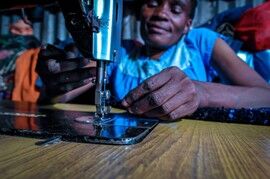
Biclaire Shukrani Hota did not imagine a sewing machine would become her way out of hunger. She only knew that when she switched it on each morning in Kakuma refugee camp, her children might eat that day.
By Rey Bulambo.
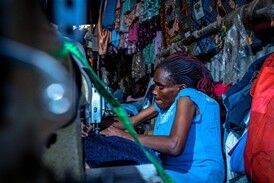
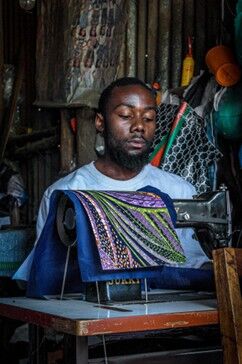
By 7 a.m., the small room Biclaire Shukrani rents in Kakuma 1 is already open. Fabric hangs from nails along the mud-stained walls. Young people sit shoulder to shoulder, cutting cloth, measuring hems, and guiding fabric beneath whirring needles.
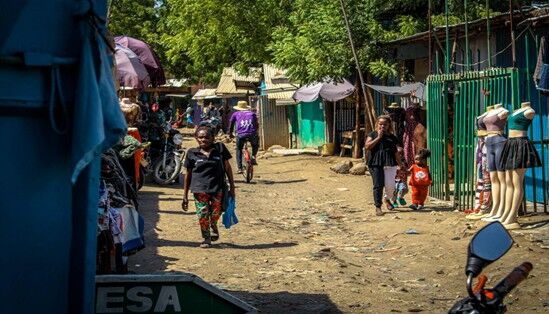
Outside, dust rises as customers arrive—refugees from neighbouring blocks, traders from the market, and, increasingly, clients placing orders from beyond the camp.
For Biclaire—a single mother, a refugee, and a woman living with a disability—the sewing machine is not symbolic. It is her livelihood.
I open this shop by 7 a.m. with my co-workers ready to receive clients and complete orders, including those from outside Kakuma,” she says, continuing to sew. “When I see the shop running well and everyone working, it gives me hope for a better future. Because of this, I have been able to move my children from public to private school and ensure they have food on the table.
Her story reflects a broader shift in refugee policy, where humanitarian systems increasingly promote self-reliance, even as structural barriers to formal employment and mobility remain firmly in place.
Aid dependence
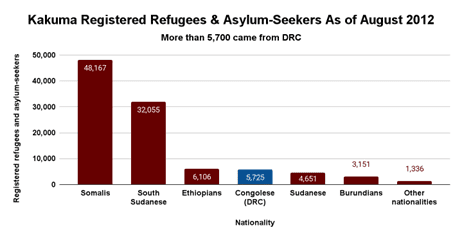
She arrived in Kakuma in 2012 from the Democratic Republic of Congo with her younger brother, fleeing persecution. More than 5,700 Congolese refugees were registered in Kenya that year, according to UNHCR.
She entered a humanitarian system designed to provide safety—but not certainty. Formal employment was unavailable. Movement was restricted. Food assistance was predictable only in its decline.
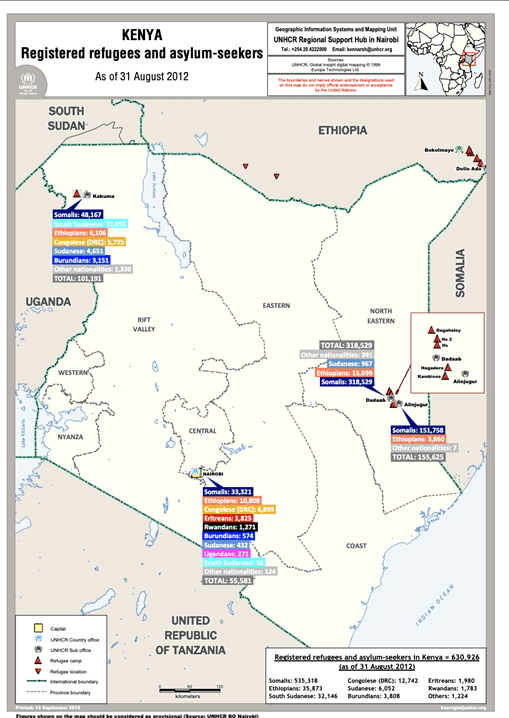
Kakuma and the neighbouring Kalobeyei settlement host an estimated 300,000 to 310,000 refugees and asylum seekers as of May 2025. This is according to UNHCR and the Kenyan government—making it one of the largest refugee-hosting areas in Africa.
Managed jointly by the Kenyan government and UNHCR, the settlement operates under policies that restrict movement and limit access to formal labour markets. More than half of the population is women and children. Many, like Biclaire, live with disabilities or carry caregiving responsibilities that further constrain their ability to earn.
For years, Biclaire relied on aid. Then the aid began to shrink. “You still have responsibilities. You still have children. But the food is less,” Biclaire says.
Shrinking aid
According to the World Food Programme (WFP), food rations in 2025 were reduced to between 28% and 40% of the daily allowance, while cash assistance was suspended due to funding shortages.
Global acute malnutrition rates have exceeded 13%—three percentage points above emergency thresholds—raising concerns about worsening food insecurity among refugees in Kenya.
These cuts reflect broader funding shortfalls across humanitarian systems, where protracted refugee situations remain underfunded despite rising needs. The impact was immediate. Households reported skipping meals, selling essential items, or taking on debt.
Youth unemployment in Kakuma—already estimated to exceed 60%—worsened. For women heading households alone, and for people living with disabilities, the risk of extreme poverty deepened.
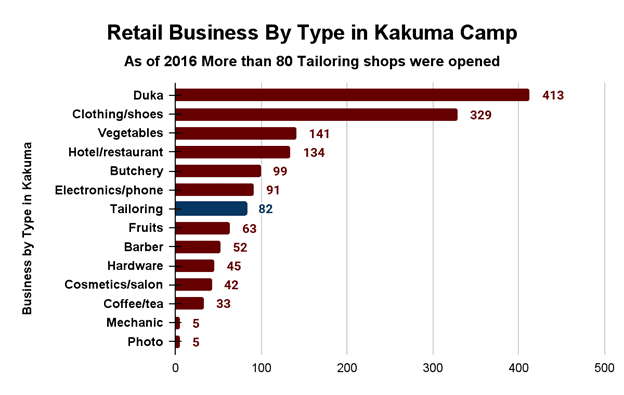
In a context where movement is restricted and formal employment is scarce, informal businesses have become one of the few viable coping mechanisms. UNHCR estimates that more than 2,000 refugee-run enterprises operate across Kakuma and Kalobeyei, ranging from tailoring shops and grocery stalls to salons, cafés, and electronics repair kiosks.
This informal economy operates largely outside formal regulatory frameworks, underscoring both the resilience of refugees and the limitations of existing policies in supporting sustainable livelihoods.
Self-reliance shifts
For Biclaire, waiting for assistance to return was no longer an option. In 2021, she rented a small room and began working with two sewing machines she paid to use. At first, she worked alone—taking small tailoring jobs from fellow refugees, mending clothes, sewing dresses, and making school uniforms. The income was modest, but unlike aid, it was predictable.
What began as a personal effort to survive, soon began to grow. As orders increased, young people started asking to learn. Many had completed secondary school or vocational training but found no work inside the camp. Biclaire allowed them to stay, teaching them how to sew, price their work, and manage customers and deadlines.
“It was not planned,” she says. “I just knew I could not survive alone.” Her decision came at a time when humanitarian policy was shifting. Government frameworks and international agencies increasingly promote refugee self-reliance, women’s economic empowerment, and the inclusion of persons with disabilities. Yet these ambitions often outpace the structural reforms needed to support them.
At a broader level, such efforts align with continental commitments under Agenda 2063 and the African Union’s Gender Equality and Women’s Empowerment Strategy, both of which emphasise economic inclusion and self-reliance. However, implementation gaps at national and local levels continue to limit their impact in refugee settings.
Funding mismatch
In principle, refugees are encouraged to build livelihoods. In practice, less than a quarter of humanitarian funding is directed toward long-term income generation, with the majority still allocated to food assistance and emergency response.
“Women, single parents, and people with disabilities are hit the hardest,” says Clement Otiang of the Build Up project under GIZ. “They carry family responsibilities while facing physical, social, and economic barriers that limit their ability to earn.”
Disability adds another layer of exclusion. According to UNHCR, refugees living with disabilities are twice as likely to be unemployed as those without disabilities and are significantly more dependent on aid.
Inside Biclaire’s shop, however, those statistics begin to loosen their grip. Orders now come from across the camp and beyond it. Clothes are made on request, with payments sometimes sent by clients outside Kakuma—including from the United States, Canada, and Australia, where former refugees have resettled. The income sustains Biclaire’s household and keeps the business running.
She has since opened a second tailoring shop, now managed by her brother, Dieumé Hota. To date, Biclaire has trained more than ten young people. Some have since been resettled abroad and continue working as tailors.
Others remain in Kakuma, either working with her or running their own businesses. One former trainee, Faraja, now operates a tailoring shop next door to hers in the Ethiopian market of Kakuma 1.
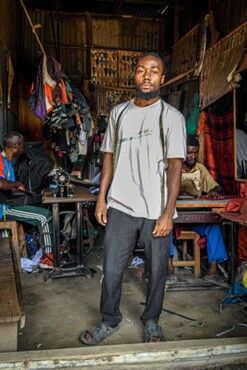
“For someone like Faraja, seeing him open his own shop makes me proud,” Biclaire says. “It shows that the mentorship is working.” For Faraja, the opportunity was rare.
“When I arrived in Kakuma, I saw many people struggling to find work, even with an education,” he says. “That pushed me to seek help from Biclaire. Now I run my own tailoring business and work with other young people who have had no opportunities.”
Ripple effects
The ripple effects are tangible. Each trained tailor supports dependents. Each business reduces reliance on food aid. Customers access affordable services within the camp rather than travelling long distances or relying on charity.
On average, earnings can reach up to KSh 1,500 per day. Yet refugee-led enterprises like Biclaire’s continue to operate on the margins.
Despite growing emphasis on self-reliance, structural barriers still limit the scale and sustainability of such businesses. Access to finance remains constrained. Refugees cannot easily open bank accounts or secure loans. Work permits are difficult to obtain. Livelihood programmes often prioritise short-term training over long-term business support.
“It is not only about implementing policies,” says Clement Otiang. “It is about guiding people on how to access resources, especially finance. Someone like Biclaire has the potential, resilience, and skills. With mentorship and capital, she could do much more.”
He adds: “Her story exposes a deeper contradiction in humanitarian aid. While self-reliance is widely promoted, systems often remain structured around control and short-term relief. Refugee-led livelihoods challenge this by showing that, when given space and trust, refugees can support themselves and others.”
In that sense, the failure lies not with aid recipients but with systems that reinforce long-term dependency while excluding women, youth, and people with disabilities from meaningful economic participation.
Inside the shop, the sewing machines continue humming. Young men and women work quietly, focused on their tasks. Outside, customers wait. The business does not erase the hardships of camp life—the ration cuts, the restrictions, the uncertainty—but it shifts something fundamental.
“It started because I needed to survive,” Biclaire says. “Now it is about helping others survive, too.” In a place where aid can disappear overnight, that difference is clear. What remains uncertain is whether policy frameworks will evolve quickly enough to match the realities refugees are already navigating.
Streamers
Food rations in 2025 were reduced to between 28% and 40% of the daily allowance, while cash assistance was suspended due to funding shortages.
Less than a quarter of humanitarian funding is directed toward long-term income generation, with the majority still allocated to food assistance and emergency response.
Access to finance remains constrained. Refugees cannot easily open bank accounts or secure loans.
The failure lies not with aid recipients but with systems that reinforce long-term dependency
This story was produced as part of the Vice Versa Global Seats of Change fellowship, implemented under the GIZ AU AWARE (Promotion of Human Rights and Empowerment of Women in Africa project.
Leave a Reply