Thirty Years of Wooden Lessons: AMO’s Unfinished Conversation on Early Childhood Education
Education should feel like an opportunity, not an obligation.
Growing up, meaningful learning you could see and touch was mostly limited to Montessori schools, a path only families who could afford it ever chose. For everyone else, the public school system was the alternative, and too often that meant abstract learning: pupils memorizing concepts they had never seen or interacted with. A few adapt. Many others move through the system with weak foundations, a gap visible in our standardized test results like BECE and WASSCE.
This is why it was refreshing to encounter the work of the Amo Programme Company Limited, which has spent 30 years putting visual and tactile learning materials into classrooms, helping children understand concepts through experience rather than imagination. That milestone is being marked throughout the year with a series of planned activities, opening with a tree-planting initiative across several districts, a fitting act of restitution for a company whose wooden materials begin as trees, and continuing with an exhibition that brought together district and municipal education directors, early childhood coordinators and civil society representatives for a round-table conversation, a walk through thirty years of AMO’s journey in photographs, and a tour of the workshop where the materials are made.
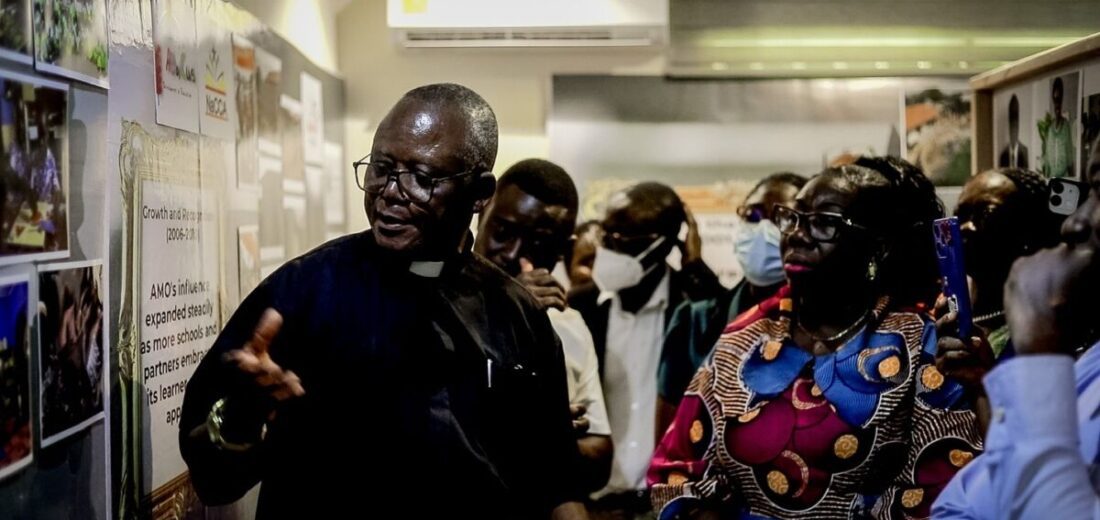
It was encouraging to see stakeholders such as Mrs. Adisa Tassa (Director of Early Childhood Education, GES), Mrs. Ivy Asantewaa Owusu (Eastern Regional Director, GES), and Rev. Dr. Amfo Akonno, AMO’s Vice Chairperson, all aligned on the importance of practical learning at the foundation level.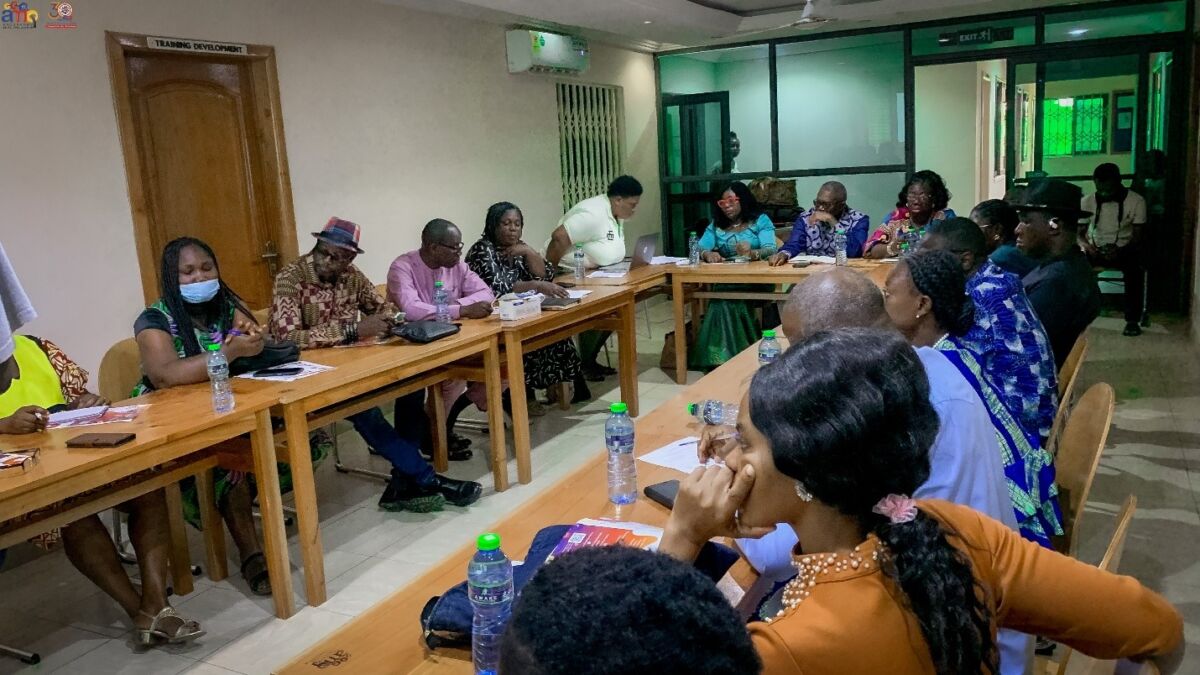
Children do not merely receive knowledge
The program opened with a remark from Rev. Dr. Amfo Akonno, AMO’s Vice Chairperson, who set the tone, on the relevance of the gathering and the structural work that needed to be done within the early childhood fraternity.
“We want you to see more than products, we want you to see a philosophy. To see people. To see innovation. To see local enterprise. And above all, we want you to see our commitment to Ghanaian children and their education. Today’s visit is not intended to end with a tour of our facilities, we have invited you because we want to listen to you as much as we want also to share with you,” he told the gathering.
With the Ghana Education Service holding the reach to shape education nationally, and the Ghana National Education Campaign Coalition carrying the voice of civil society, and AMO carrying three decades of material and pedagogical experience, what could they do together that none of them could achieve as effectively on their own?
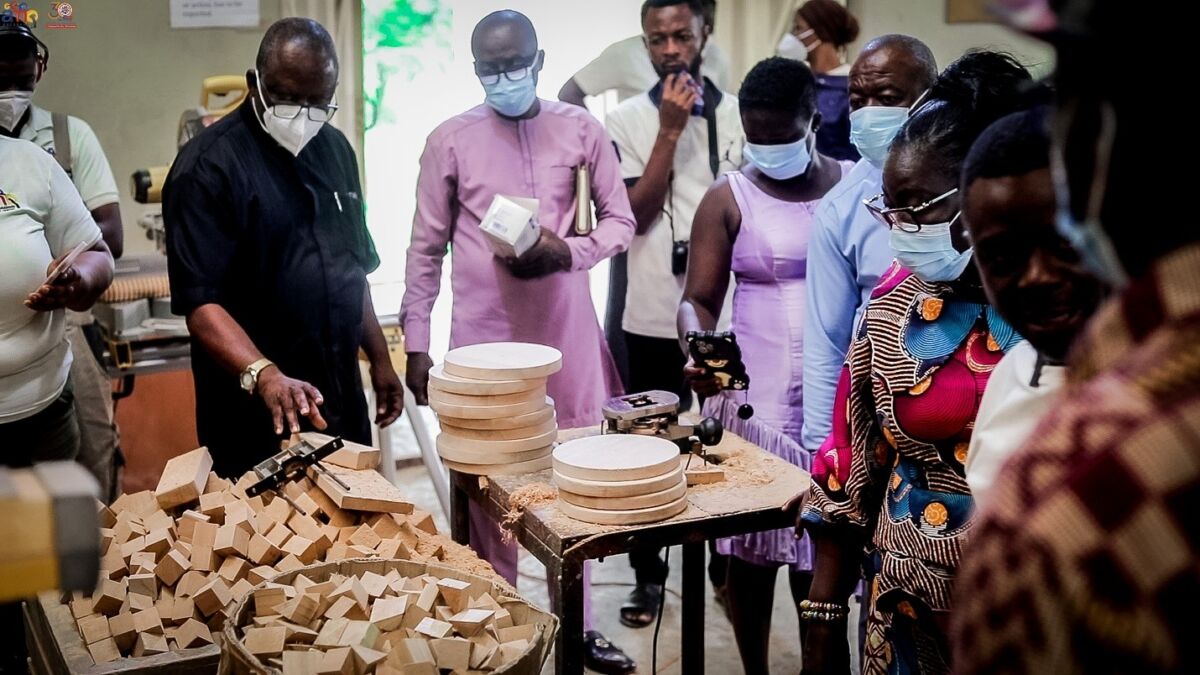 Rev. Dr. Amfo Akonno, AMO’s Vice Chairperson in black, taking attendees through AMO’s workshop
Dr. Akonno’s framing of the problem reached back to his own education. Recalling his master’s degree, he described a system built on intellectual replication of the lecturer: “If you are not able to produce what they have told you, you fail.” It was only during his doctoral studies in the United States, he said, that he encountered the opposite instinct, where a supervisor would push back on a student who simply repeated what they had been told.
He connected that memory directly to the Ghanaian classroom, and to the late Professor Ali Mazrui’s description of Africa’s “triple heritage” and its uneven relationship with modernity. For Dr. Akonno, the fix begins early, and it begins with what children are allowed to do with their hands, not just their memories.
“If we can make the classroom a place where children do not merely receive knowledge, but actively construct an understanding, we will have taken seriously new steps towards improving educational outcomes in this country,” he said.
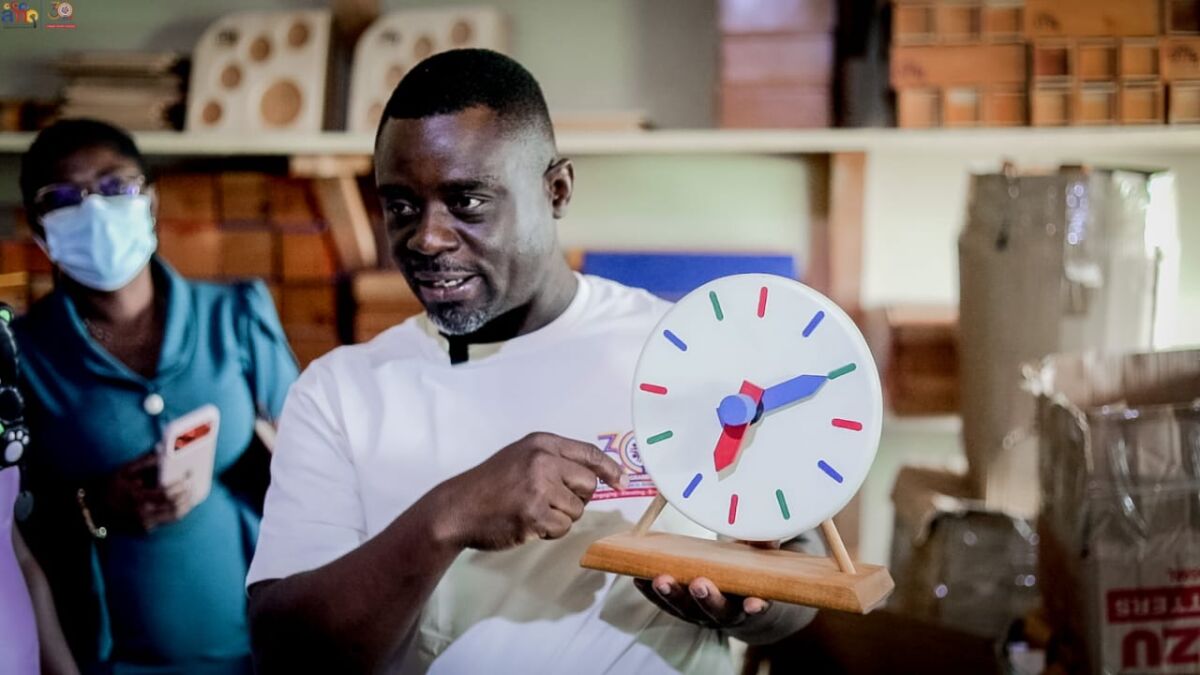
It is, in effect, AMO’s founding argument restated for a room full of the dignitaries who run the public school system: a child who has held a shape, sorted a material, or built something with their own hands has understood it in a way rote memorization cannot replicate. The thirty-year affirmation of that idea, in wood, was waiting down the corridor.
The Persistence of the Teacher-Centred Classroom
Mrs. Ivy Asantewaa Owusu, GES Eastern Regional Director, supplied the reality check. Her intervention returned repeatedly to a single obstacle: the physical and professional conditions inside the average Ghanaian public-school classroom make the kind of active, learner-centred teaching AMO champions genuinely difficult to practice.
“Looking at the number of children we have in a class,” she said, describing overcrowded classrooms where a teacher cannot move freely among learners, “it tells the teacher to go back to the previous [approach], where the teacher will stand in front of the children and tell them, do this, do that,” rather than allowing children to explore on their own. She named the second obstacle just as plainly: “Teacher attitude, teacher not being innovative, also poses a barrier for the teacher moving forward.”
It was a rare moment in the discussion where the conversation moved past materials and toward the people expected to use them, a reminder that a beautifully produced wooden learning tool sitting unused in a cupboard is not a rare hypothetical in Ghanaian public schools, but a recurring, named problem in the room.
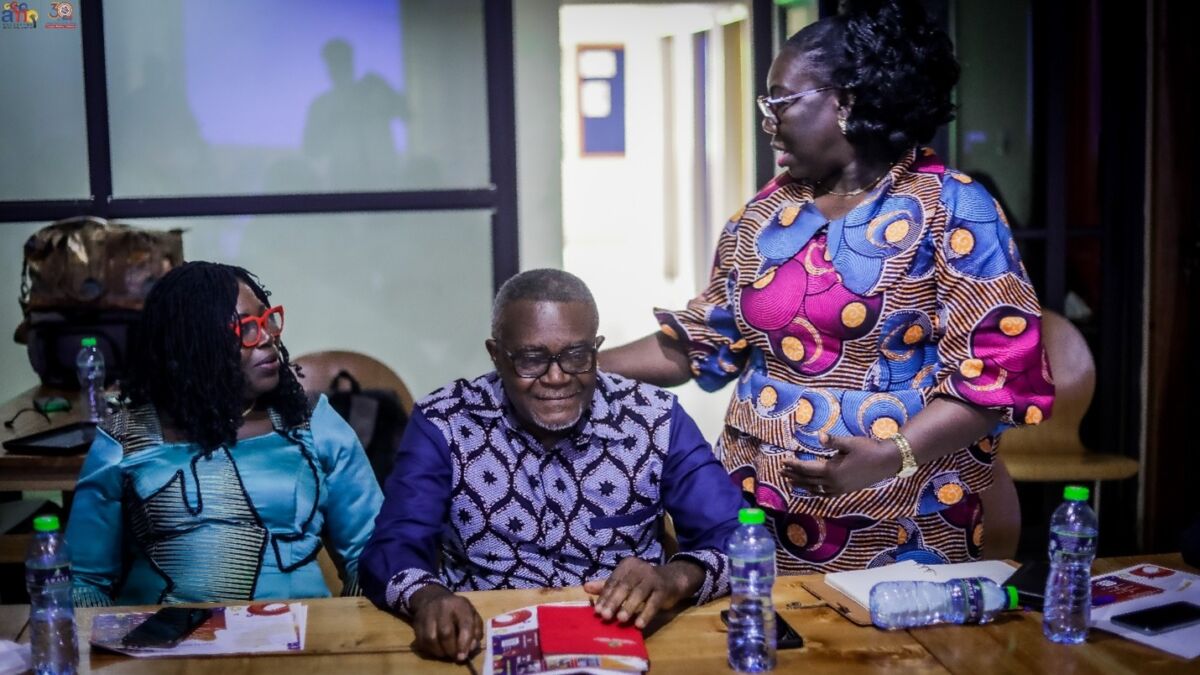 Mrs. Adisa Tassa, Director of the Early Childhood Education Unit at GES on the left, Charles Y Aheto-Targaryen GNECC Technical Advisor in the middle, and Mrs. Ivy Asantewaa Owusu, GES Eastern Regional Director at the extreme right
Infrastructure as Pedagogy: Relocating the Early Childhood Learner
Mrs. Adisa Tassa, Director of the Early Childhood Education Unit at GES, brought the discussion down to the level of physical infrastructure, and her account was striking. She described how early childhood classes in some schools had been housed inside catering structures, kitchen-adjacent spaces considered unsafe in the event of an emergency, prompting one Member of Parliament, as chair of a select committee, to intervene directly.
“He moved all the early childhood children to cozy classrooms, and then the furniture that he provided for them was child-appropriate,” she recounted.
Mrs. Tassa framed this less as a resolved success story than as an argument for replication. Government, she noted, is building 200 kindergarten classrooms across the country, but the surrounding environment, sanitation, safety, general upkeep, remains the responsibility of district and municipal assemblies. Her call to the coordinators and directors in the room was to become advocates within their own assemblies. She noted she had already seen movement in some assemblies in the Eastern Region, evidence, she suggested, that pressure applied locally does produce results.
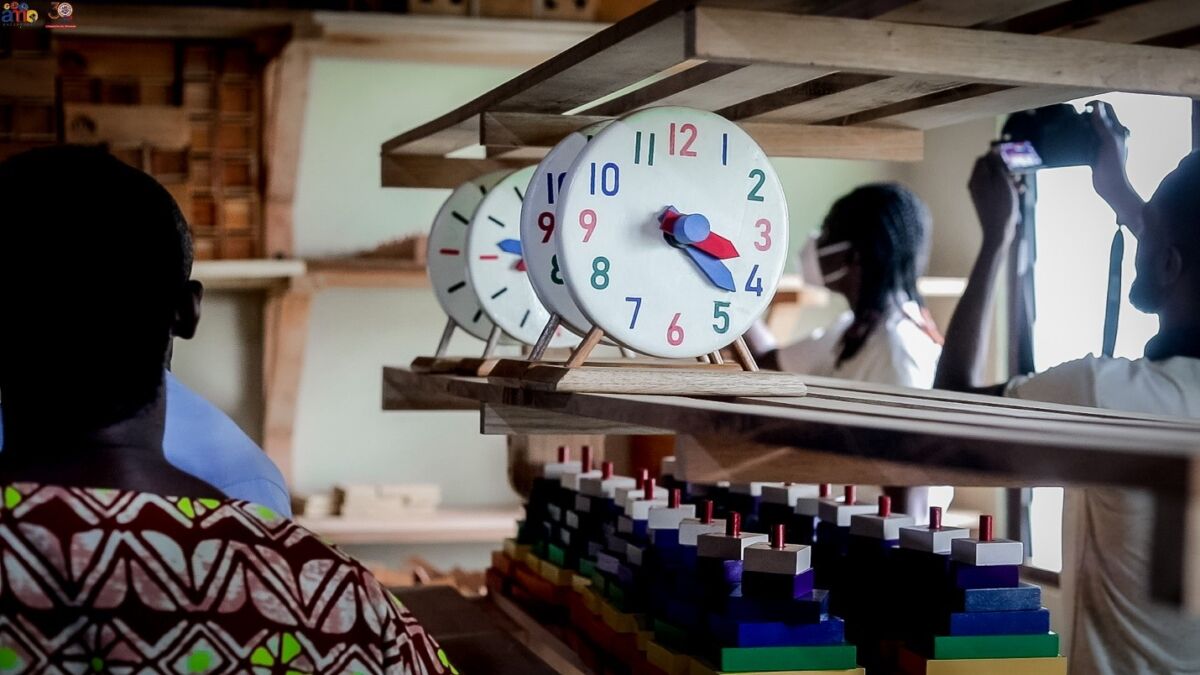 AMO’s learning materials on display
The Staffing Deficit and the Limits of Pedagogical Reform
The staffing question arose from other early childhood coordinators, and it may have been the discussion’s most concrete indictment of the system as it currently stands. An early childhood coordinator described classrooms where a single teacher is compelled to switch between multiple classes at the same time, managing what could be KG 1, KG 2 and a Class 1 stream simultaneously, or, in other cases, a single class of seventy children.
Under those conditions, he argued, active, materials-based learning becomes nearly impossible to practice. His proposed fix targeted recruitment policy directly: that hiring should give real weight to candidates holding early childhood education certificates specifically, rather than treating a general teaching qualification as sufficient preparation for a kindergarten classroom.
A Dual Archive
After the round table closed, the dignitaries, among them Mrs. Tassa, Dr. Ivy Asantewaa Owusu, and district directors from Kwahu East, Kwahu South, Kwahu West, Birim North, Fanteakwa South and beyond, were led into the photo gallery Dr. Akonno had promised. It traced AMO’s journey “from beginnings through periods of growth and periods of challenges to the partnerships and innovations that have shaped us today,” in his words, a visual record of thirty years spent trying to put something tangible into children’s hands in a system that has often asked them only to imagine.
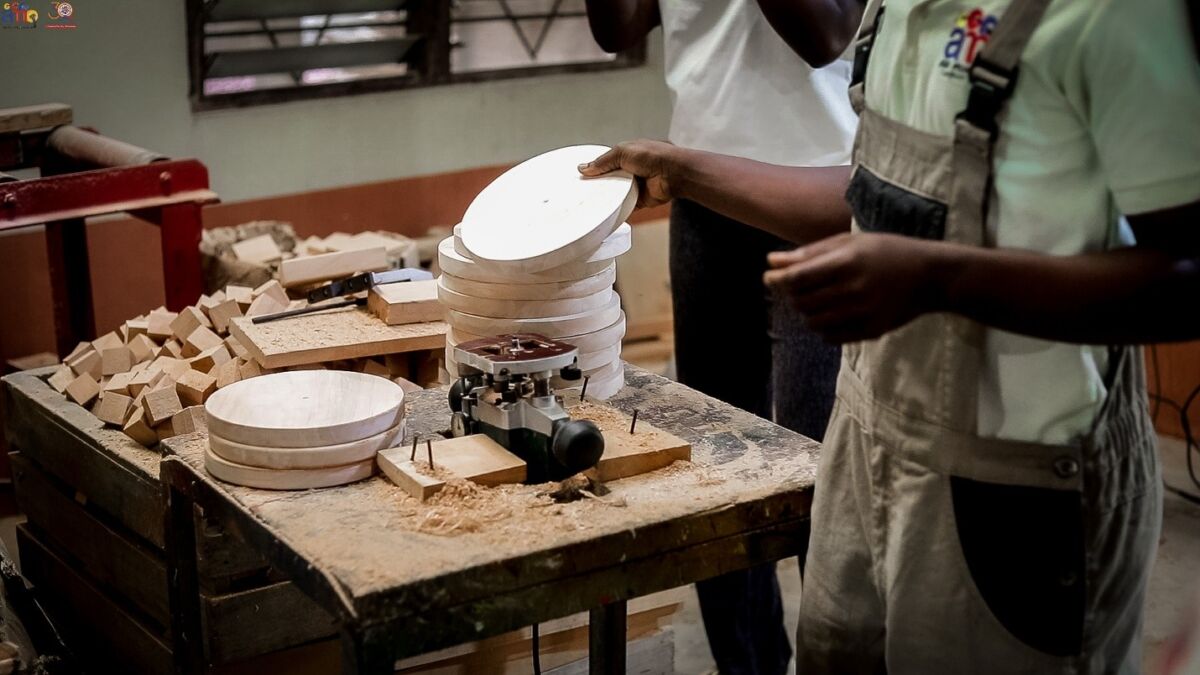
From the gallery, the tour continued to the production floor itself, where the wooden materials are still cut with machines, shaped and finished by hand, using processes AMO describes as safer and more sustainable than the alternatives.
Seeing the raw material become a finished teaching tool gave the day its sharpest edge. This was, after all, the same visit that opened with a debate about whether that tool ever reaches, or gets used in, an actual public-school classroom. Here was a company that has spent three decades solving the materials problem, sitting across the table, listening and having an honest conversation about the future of early childhood education.
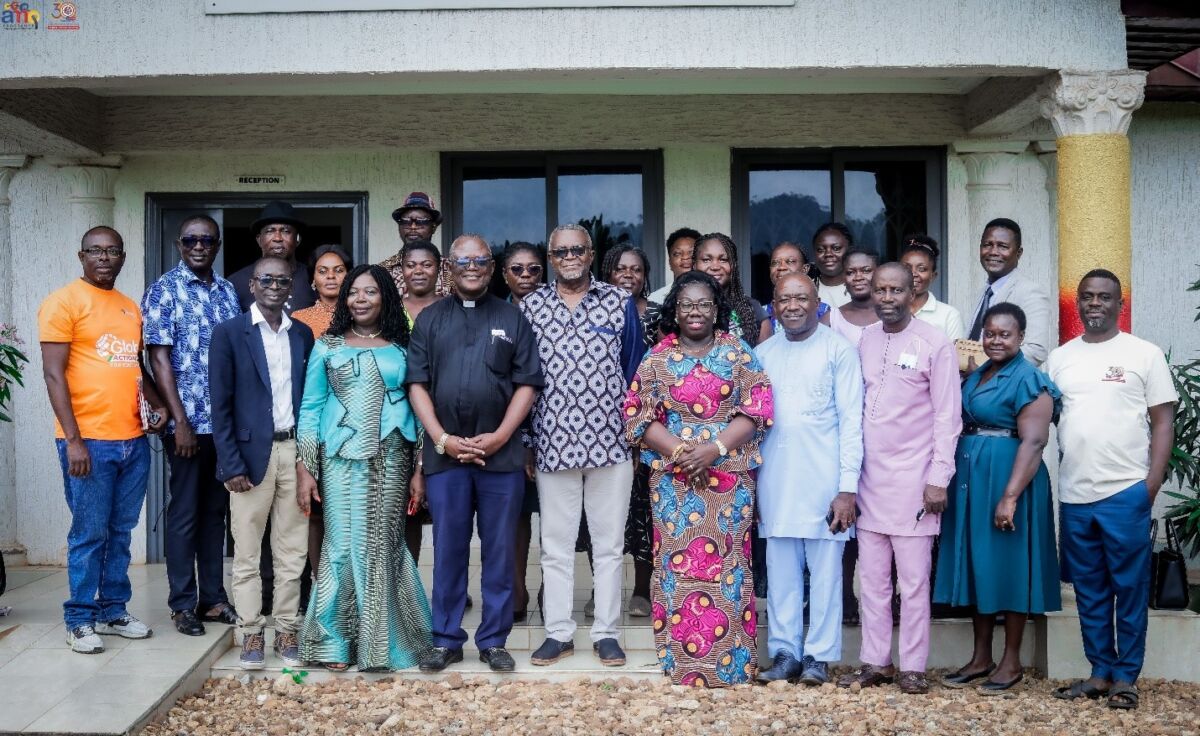 A group picture of district and municipal education directors, early childhood coordinators and civil society representatives
The Question of Scale
Nothing said inside that room or that gallery suggested AMO’s model does not work. If anything, the alignment among the GES and civil society voices in the room, on the value of practical, tactile early learning, was unanimous. What remained unresolved, and what every intervention from the floor kept circling back to, was whether the conditions exist to take that model beyond the schools it has already reached.
If this approach is working, then it should not remain limited. There is a need for stronger partnerships and deliberate efforts to expand models like this across more public schools. Because every child, regardless of background, deserves access to learning that builds understanding, confidence and curiosity.
Education should not be endured. It should be experienced.
Leave a Reply