When Africa Starts Believing Its Own Stereotypes
The belief that Western expertise is superior runs deeper than many are willing to admit. It influences whose ideas are taken seriously, who receives funding and even how Africans value their own achievements. At Debunking Notions in Kampala, participants turned the spotlight on these deeply rooted assumptions, exposing uncomfortable truths about prejudice, identity and the persistent search for Western approval.
A Ugandan millionaire invites a Dutch journalist to lunch at an expensive restaurant. The meal is excellent. When it is over, the host gets up and leaves with his entourage. The bill 1.6 million Ugandan shillings remains on the table, in front of the Dutch guest. Marc Broere tells the story with a smile, but behind that smile shows the real-world scenario between Africans and whites. After more than three decades of travelling through Africa, he has become accustomed to waiters assuming that the white person will pay.
But there is a second story. More recently, while dining with Ugandan filmmaker Cissy Nalumansi and others, Broere found himself questioning Cissy when she offered to settle the bill. Was she sure? Really sure? Cissy challenged him: why should her offer to pay seem so unusual? The assumptions, Broere realised, were his own as well.
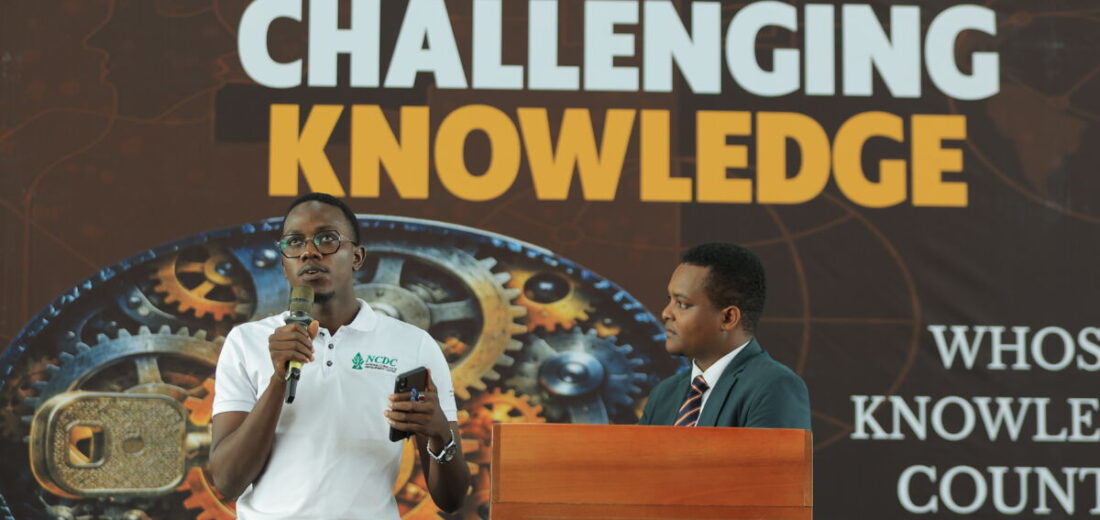
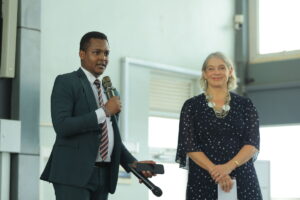
Those small encounters captured the spirit of Debunking Notions, a gathering at the National ICT Innovation Hub in Kampala on Wednesday, 11 November 2026. Initiated by Nalumansi of Mpologoma Media and Broere of Vice Versa Global, the event brought together young people, creatives, diplomats, educators, policy advocates, technology professionals and people working in agriculture. Their shared challenge was to examine the stereotypes and inherited ideas that shape relationships between Africans and Europeans and among Africans themselves.
The discussion went well beyond individual prejudice. Who is considered an expert? Whose ideas attract funding and respect? Why are some people expected to provide solutions while others are expected to receive them? And how can international cooperation become a genuine exchange of knowledge, experience and resources? NTV journalist Canary Mugume moderated a day intended to make participants question assumptions they may never have noticed, pressing speakers and the room alike to look beneath polite generalities at what people actually believe.
Two lenses, one problem
The organisers described perceptions that can limit cooperation on both sides. Africans may be portrayed as vulnerable and dependent on outside assistance, while white people are assumed to possess money, authority and expertise. Those stereotypes can shape everyday encounters, institutional decisions and the way development programmes are designed.
The Netherlands’ ambassador to Uganda, Angèle Samura, reflected on the images people hold of other countries and on her own experiences. She spoke of assumptions linking Uganda to insecurity and disease, as well as moments when people appeared to assume that she was wealthy. Even within her own marriage, those reflex assumptions surface: married to a man from Sierra Leone, Samura noted that onlookers frequently assume he is her driver.
Participants also questioned the tendency to look abroad for financial support and validation, arguing that African institutions and individuals already possess resources, ideas and expertise of their own. The room lingered on an uncomfortable question: why do Africans sometimes place greater trust in an idea only after a foreigner has endorsed it?
The mirror image
Held up to the room, the mirror reflected both sides of the divide showing how Europeans often misread Africa through outdated scripts, and how Africans can end up measuring themselves against foreign standards.
Broere drew on his first visit to Uganda in 1992 to show how much the country has changed and how slowly perceptions sometimes catch up. Kampala, he recalled, was a very different city. Today he sees a dynamic capital, with a generation of young people whose technological skills and creativity he values. When his laptop or phone needs fixing, he said, he sometimes waits until he reaches Uganda or Kenya because he knows people there who can repair it quickly. Yet before he travels to Uganda, people in the Netherlands still ask him questions that seem rooted in a distant past: about hunger, violence, or even Idi Amin, the former dictator. The country they imagine bears little resemblance to the Uganda he knows. Looking across the room, Broere also asked why a young European might still receive greater attention or credibility than an equally knowledgeable Ugandan sitting right beside them.
Nalumansi turned that mirror inward, starting with her own first trip to Europe. When she posted a photo on WhatsApp, a friend urged her not to return, telling her not to waste a visa that could take her anywhere in Europe to start a “better life” and even suggesting dating apps to find a mzungu because “nothing is better than Europe.” Walking through winter streets and seeing homeless people and later watching footage of Africans sleeping rough in France during the Olympics forced her to question why so many graduates dream of leaving while overlooking opportunities at home.
That fascination, Nalumansi argued, is planted early in school curricula that teach students to romanticise European landmarks, monarchs and history from the Canadian prairies, the Swiss Alps, Napoleon and Marie Antoinette to the Vienna Convention while giving far less depth to their own lineage. “We are white on the inside but still black people out,” she said, describing the strain of living with an identity pulled in conflicting directions.
She also pointed to how skin colour and proximity to Europeans shift treatment in everyday spaces. Moving through public offices or even church with her Dutch colleague Marc brought immediate deference front-row seats, a microphone, or prayers for “mzungu miracles” and a visa abroad alongside assumptions that he bankrolls her. Yet in her experience, everyday generosity often flows the other way, even when people are stretching to share a modest sum like 20,000 shillings. And she called out the pressure on young women to marry white men for status or alter their skin and hair to match a narrow ideal of beauty reinforced by songs and television casting choices. “HOW LONG ARE WE GOING TO KEEP UP WITH THESE STEREOTYPES?” she asked. “Can we unlearn? Isn’t it time to challenge what we know?”
That tension between looking outward for validation and trusting what is built closer to home echoed across the speakers, participants and Mugume’s probing moderation, finding voice too in spoken word performed during the gathering that traced how easily minds are drawn toward distant validation:
The anchors of the mind are cast in distant, colder seas,
where justice wears a foreign robe and speaks in foreign pleas.
Across the miles of rolling green, the pearl begins to fray,
as leaders turn their weary eyes to lands a world away.
Why does the heart of Africa, so ancient and so deep,
entrust its sacred grievances to those who do not sleep
Beneath the same wide, burning sun, or walk the red-clay dust?
We’ve traded in our inner strength for a fragile, borrowed trust.
The scars of old are etched in stone, a phantom in the brain,
A whisper that our own decree is somehow less than sane.
“Go find the ones who drew the lines,” the quiet psyche cries,
“For truth is only valid when it’s seen through Western eyes.”
But sanctions are a paper shield, and flight is but a breath;
A nation cannot heal its soul by flirting with its death.
To build a house that stands the storm, the stones must be our own,
Not gathered from a distant shore or begged from a golden throne.
The power is not in Brussels’ halls, or in a London Street,
it’s in the pulse of Kampala, where the common heartbeats meet.
To break the chain of “Savior-Seek,” we must at last believe:
The hands that sow the African soil are the only ones that weave.
From discussion to practice: the workshops
In the afternoon, the gathering broke into smaller workshops where participants tested the day’s ideas against realities in their own sectors spanning filmmaking and storytelling, agriculture and farmers’ knowledge, and locally led development.
In the agriculture session, participants zeroed in on how innovation is introduced to rural communities. Rather than treating farmers as passive recipients of external tools, the group emphasised genuine knowledge sharing among partners insisting that agricultural technologies must be built alongside farmers themselves, because they know their own soil best.
Down the hall, the filmmaking workshop moderated by Ugandan filmmaker and promoter Benda sparked one of the liveliest debates of the day, opening with a deceptively simple question: Are Ugandan films good?
The room immediately split. Some participants defended the industry’s progress, while others argued that local productions still struggle with tight production budgets, weak scripts and the narrow lenses through which Ugandan filmmakers sometimes portray their own society. Yet several voices pointed out that the yardstick itself is skewed: audiences who grew up watching Hollywood blockbusters often judge local cinema against an external standard. Others noted a more practical hurdle many Ugandans do not watch local films simply because poor marketing leaves them unaware the films exist, or because language choices exclude large segments of the national audience.
Benda pressed the room further on authenticity, challenging filmmakers to examine how far they are willing to bend and highlight the worst features of their own country just to secure funding from Western donors. Whoever feeds you controls you, participants observed, pointing out that donor and external funding often dictate which stories get told and how Uganda is framed on screen. Still, one participant pushed back against using funding constraints as an excuse for compromise, urging filmmakers not to let money drain their work of authenticity and instead to sharpen their craft so thoroughly that funders seek them out without stripping away their originality.
By the end of the session, the group converged on a clear takeaway: building an audience for Ugandan cinema has to start at home. Parents, they concluded, should introduce their children to Ugandan films early so they grow up knowing local stories exist and Ugandan television stations must step up by airing local productions during prime movie slots instead of defaulting to Hollywood imports.
What would equal partnership look like?
Across the rooms, the debate returned repeatedly to the real-world consequences of the stories people believe. If a community is described mainly through its needs, outsiders are invited to design solutions before local people have had a chance to shape the questions. If an organisation believes a foreign face makes a proposal more credible, that assumption determines whose leadership is recognised.
Participants questioned why ideas associated with Africa can be dismissed while similar ideas from elsewhere are treated as innovative, while others challenged the assumption that financial resources must always come from outside the continent.
For the organisers, equality begins with a willingness to examine the assumptions each person brings to the table. The lesson from Broere’s two restaurant stories was that no one stands outside those habits: he could recognise the expectation that a white guest would pay and still find himself surprised when Cissy offered to do exactly that.
As the day wound down, Nalumansi acknowledged that a single gathering could not dismantle entrenched stereotypes overnight but insisted the work was already walking out the door with the people in the room. Thanking the young people who had turned up and stayed engaged, she urged them to take the conversation into their everyday circles: to share what they had unpacked with friends, families and anyone they meet, to post online and tag Debunking Notions and Vice Versa Global so a wave of collective voices could spark wider debate, and above all to live out what they had learned.
Leave a Reply