Some journeys begin with departure. Others begin with a choice that never stops echoing. Along the Nile at Pakwach, where a brother turned away, and another chose the water, the story of Alur unfolds—carried by memory, anchored in land, and still moving, five centuries on.
Our elders say: Gipir first planted his spear where the Nile bends sharply at Pakwach, claiming the ground our feet still stand on today. Five centuries later, we still plant ours in that same soil.
This is Alur: a kingdom carried by river and rhythm, stretching from the roar of Murchison Falls to the hills of Zombo. From the waters that carried Gipir to the firelight where his name is still spoken, this is a journey traced in our own footprints.
The sweetest journey yet to be fully walked is the journey through Alur land, where a river still remembers a quarrel and the hills echo the footsteps of a man who chose the spear over his brother.
Here, the earth remembers names. The wind carries arguments five centuries old. Even the sky itself once paused to watch. If you are looking for a place you can finish in a weekend, turn back. Alur is not a stop. It is a return.
It begins at Wanglei, in Pakwach. There is no plaque, no gift shop, no statue of two brothers standing back to back. Only river, wind, and the kind of silence that settles after a family breaks apart. This is where the brothers Labongo and Gipir separated over a bead, a spear, and words that could not be swallowed.
Labongo turned one way. Gipir took the water. We, the Alur, are the descendants of Gipir, while Labongo became the ancestor of the Acholi. That split became our first mile, and centuries later, we are still walking it.
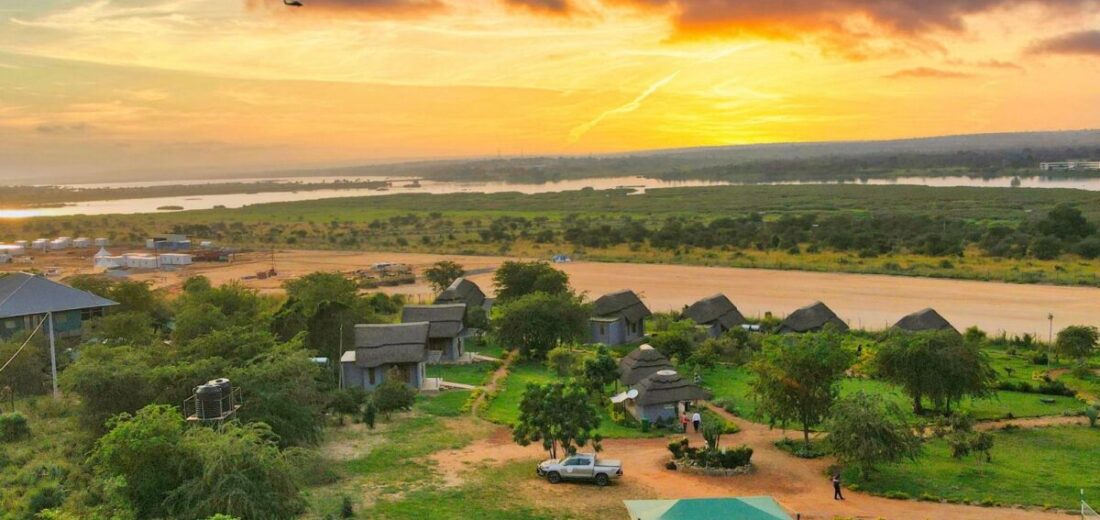
From that painful farewell at Wanglei, the river carried Gipir, and it carried us too. By dawn at Pakwach Bridge, the Nile is already alive with movement, brown and wide, as canoes slide off the sandbanks and fishing nets rise silver from the deep.
The tools have changed since Gipir’s crossing, but the current is still the same. Follow it westward, and the Nile opens into Lake Albert at Panyimur. Smoke and salt linger in the air as women sort fish on drying racks, while across the water, the hills of Mahagi stand close enough to seem within reach—a colonial border drawn in 1914 divided maps, but not kinship. Weddings and funerals still cross it as easily as gossip.
Yet Pakwach does not only hold beginnings. Sometimes, it holds the sky itself. On November 3, 2013, the sun disappeared at midday as a total solar eclipse crossed Uganda, with Pakwach directly beneath the path of darkness. For three minutes, the Nile fell silent. Birds stopped singing. The air cooled.
Then the ring of light returned, and people erupted in cheers as though they had reclaimed something precious. Scientists arrived with telescopes. Our elders arrived with stories. They said the sun and moon were settling an ancient debt, just like brothers do. For a brief moment, the world looked at Pakwach not for oil or war, but for shadow and light.
The sacred sites
The place that witnessed Gipir’s departure also witnessed the sky itself disappear. We take that as a sign: this is a land where great things begin, and where even the heavens pause.
To understand how we survived that separation at Wanglei and still stand firm when the sun disappears, you must hold two places in mind at once. The first is Kaal Aker, near Nebbi. This is the seat of the Alur Kingdom, where the king resides and where chiefs gather to settle disputes, organise ceremonies, and safeguard tradition.
The royal throne rests here, alongside drums, spears, and crowns, each carrying its own name and history. On Cultural Day, the compound fills with people, and the sound of the royal drum is felt in the chest before it reaches the ear. Behind the main house, past kings rest beneath frangipani trees. Kaal Aker is the face of the kingdom. It governs, it receives, and it speaks for the living.
The second place is Kaal Atyak Winam, perched on a hill in Paidha, in Zombo. This is the spiritual heart of the Alur. No governance takes place here. No dances are performed for visitors. Instead, spirit mediums come to consult the ancestors whenever the kingdom faces questions too great for human judgment alone, such as drought, illness, succession, or peace between clans.
Offerings of grain, beer, and tobacco are left among the stones, and when the prayers end, the wind rises from the valley below. We take that as an answer. The king of Kaal Aker does not make decisions on major matters until Atyak Winam has been consulted. One home speaks. The other listens. Together, they keep the kingdom standing upright.
The unseen also runs through other sacred places. Near Zeu lies Wipolo, a healing shrine where cloth from the sick is brought, and knots are tied and untied in ritual prayer. The ground there is darkened by soot and whitened with feathers, while the air hangs thick with the scent of shea smoke.
Here, the ancestors are asked to mend what medicine cannot yet reach. Belief is not reserved for a single day of worship. It is woven into how we plant, how we bury our dead, and even how we name our children.
Then there is Biko Hill in Goli, where a chapel so small it seats only three people is built into the rock. It is said to be the smallest church in the world. Pilgrims climb there not in search of space, but of stillness.
From its doorway, the land opens into valleys and distant waters, and the silence feels older than the bricks themselves. For a people born from the separation at Wanglei between the brothers Labongo and Gipir, and who once watched the sun disappear in 2013, perhaps it is fitting that one of our holiest places leaves room only for a person and their thoughts.
Leave the shrines behind, and the land itself rises to meet you. Those who know only Pakwach often think Alur is flat. They have not seen Zombo. East of Nebbi, the earth begins to climb.
The roads turn red, the air cools, and tea plantations stretch in neat lines across the slopes. Pine forests stand in ranks. The hills themselves carry names — Atyak, Lendu, Okoro — and each hill holds a clan, while each clan carries a story.
On market day in Paidha, the district reveals its abundance: avocados as heavy as stones, Irish potatoes, smoked meat, and high-altitude coffee washed by mountain streams. It is among the finest coffees in Uganda, though few beyond the district have ever tasted it.
Music and dance
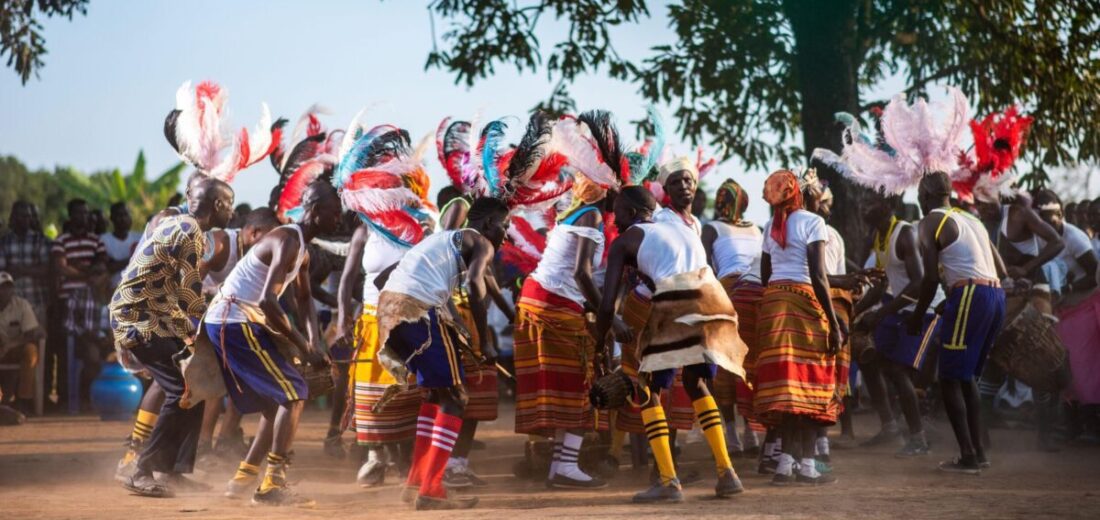
Here, culture is carried through sound and the work of human hands. Agwara is our signature performance: long wooden trumpets played in a circle, with each man sounding a single note and each movement timed to the breath. The music rises like wind, arguing with itself, and once it begins, even the elderly cannot remain still.
Ndara responds to it, with gourd rattles tied around dancers’ ankles, shaking with every stamp and turning the body itself into percussion. Together, these performances call for rain, celebrate marriages, and accompany the dead on their final journey home. There are funeral dances too, slower and heavier, where feet strike the earth so the departed know they have not been forgotten.
We eat what the land provides: fish smoked whole over open fire; greens simmered in peanut paste until tender; millet bread, dark and heavy, eaten with stew; and white ants gathered after the first rains and fried with salt until the sky itself seems edible.
Our hands shape things that are useful before they are beautiful. In Panyimur, canoes are carved from single tree trunks. In Nebbi, mats are woven from palm and dyed with bark. In Zombo, hoes are hammered from scrap metal against stone. A tourism trail that teaches visitors how to weave, carve, or cook would ensure that money remains in the homes where these skills are passed down.
Alur is not only about people and the past. East of Pakwach lies Ajai Wildlife Reserve. It is small and was once emptied by war, but the white rhinos have returned, along with kob and the shoebill, a bird that looks as though it missed the rest of evolution.
In Ajai, you walk rather than drive. A ranger who once grew up fishing these waters will point at tracks in the earth and quietly say, “A leopard passed here at two in the morning. She is pregnant.” And somehow, you believe him. Communities now receive a share of the gate fees, and so they protect what was once taken from them. Here, conservation is not an imported idea. It is our forest.
There is reason, then, for the world to spend time in Alur. The seam between past and present is thin here. You can stand at Wanglei, where brothers parted ways, watch the same sky that darkened in 2013, see the Nile that carried Gipir by noon, and hear the sound of agwara and ndara rise through the night. The kingdom still gathers. The hills still cool the skin. The coffee still wakes the spirit. The ancestors are still consulted, and they still answer.
Tourism and preservation
For years, tourism found us by accident. Now, we must choose it deliberately, not as performance, but as survival. Our children can build lives here rather than leave. We have Wanglei, where the decision was made between Labongo and Gipir.
We have the river that carried our grandfather. We have Pakwach, where even the sun once stopped to look. We have the king at Kaal Aker and the ancestors at Kaal Atyak Winam — one speaking, the other listening. We have hills that bend the clouds and the tiny chapel on Biko Hill, humble enough to quiet anyone who enters. We have agwara and ndara, whose rhythms can stop the heart for a moment and then return it.
That should be enough. Walk in the footsteps of Gipir, for we are his grandchildren. Remember where the first step away from his brother Labongo was taken, and where the sky itself once held its breath. The footprints are not ancient. We are still making them.
The story of Alur is not the story of what was lost when Labongo and Gipir turned their backs on each other at Wanglei. It is the story of what we refused to let break afterwards. Not the spear. Not the drum. Not the question.
For five centuries, we have carried two homes because a people cannot live on words alone, nor on silence alone: Kaal Aker, which speaks, and Kaal Atyak Winam, which listens. We have carried a river that was once a road, and a road that later became a border but never a wall.
We have carried the darkness that fell at noon in 2013, and the cheer that rose when the ring of light returned, because hope is not the absence of shadow. It is the decision to remain standing in the dark while waiting for fire.
We have carried agwara and ndara because grief needs rhythm, and joy needs a rattle. We have carried millet, fish, and white ants because people are shaped by what they eat and by what they share when the cooking pot is small. We have carried the three-seat chapel on Biko Hill because the deepest prayers are never crowded.
So we do not invite you to consume Alur. We will not package it. We will not reduce it to something that can be completed in a weekend. We invite you to carry it with you. Take a quarrel, to remind you that pride is costly and some words can never be swallowed.
Take a river, to remind you that even when brothers fail each other, water still finds a way forward. Take a shadow, to remind you that even the sun must bow, and that darkness is not death. Take a rhythm, to remind you that the same feet that stamp for the dead can still dance for the living. Take a throne and a shrine, a voice and an ear, to remind you that no kingdom survives on noise alone.
Gipir’s legacy and inheritance
This is Gipir’s inheritance. It is not buried beneath the frangipani trees at Kaal Aker. It is not sealed in stone at Kaal Atyak Winam. It is still walking — in the fish seller at Panyimur, in the coffee farmer in Zombo, and in the child tying ndara to her ankles long before she can even spell her own name.
Walk with us, and it becomes yours too. Not as a souvenir, but as a reckoning. The footprints at Wanglei are still warm. The sky above Pakwach still pauses. The question remains open: “What are you still carrying?” And what, at last, are you ready to set down?
As Alur elders say, “The one who is carried on the back does not know how far the journey is.” We inherited this wisdom from our forefather Gipir, who understood it at Wanglei when he planted his spear and chose the river instead of quarrelling. He knew that pride is a passenger that never walks.
We, his grandchildren, came to understand it again five centuries later when the sun disappeared at noon over Pakwach. We did not run. We stood. We sang. We waited for the fire to return, because fear, too, is a passenger that never walks.
And you, sitting far from here with this story in your hands, must now understand it for yourself: Alur can be visited, but it cannot simply be toured. It cannot be photographed, catalogued, and packed away in a suitcase between a carved drum and a beaded necklace. The bead that sparked the quarrel is gone. The quarrel itself is gone. What remains is the journey.
What remains is a river that was once a path between brothers. A sky that still pauses. A throne that speaks and a shrine that listens. You will never know how far that road stretches, how deep that river runs, or how much weight those two houses can carry until you place your own feet on the ground and choose to walk beside us.
We are not asking you to come and watch us. We invite you to come and be measured. By the distance. By the darkness, what you choose to carry, and by what you finally decide to lay down.


Leave a Reply