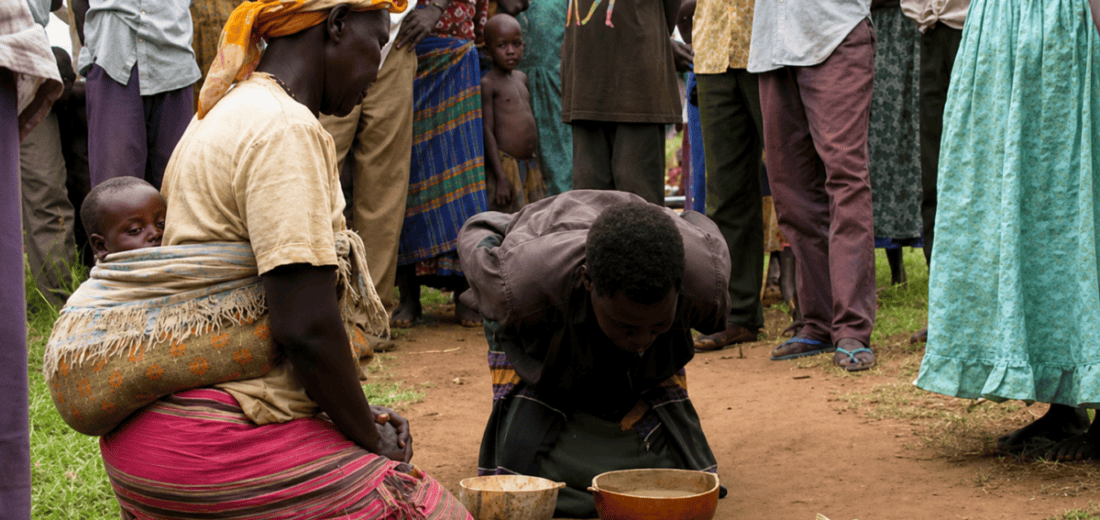
When justice is denied, and silence shields the guilty, Acholi tradition turns to a deeper force. Agat is not simply a ritual; it is a summons to truth. Invoking the living, the dead, and the unseen ensures that accountability cannot be buried, ignored, or escaped.
Following the exploration of Kal Kwaro—the Council of Elders—as the human face of Acholi restorative justice, attention now turns to Agat: a spiritual mechanism that gives that system its ultimate authority. While Kal Kwaro provides structure, Agat provides weight. It is through Agat that decisions move beyond negotiation and become binding—not only among the living, but also in the eyes of the ancestors and the spiritual realm. At its core, Agat is not merely a ritual. It is a covenant.
A binding agreement between the living, the ancestors (tipo), and the divine—one that ensures truth prevails where human systems alone may fail. By invoking ancestral witness, Agat introduces a level of accountability that cannot be evaded through influence, denial, or delay.
Agat is performed by the Kal Kwaro, who serve as custodians of Acholi tradition, justice, and social harmony. Their role is not only to mediate disputes but to ensure that justice is achieved in a way that restores balance within the community.
In Acholi society, when a person is killed, there is an established path toward justice and reconciliation. Typically, the offender’s family approaches the victim’s family through the elders. Responsibility is acknowledged, compensation is arranged, and rituals are performed to restore harmony. This process allows the offender to be released from spiritual burden, while the two families are reconciled.
But this system depends on cooperation. When an individual commits intentional murder and refuses to take responsibility—especially when they flee, deny the act, or hide behind influence—this pathway breaks down. It is at this point that Agat is invoked.
Agat is therefore not applied to accidental killings where responsibility is promptly accepted. It is reserved for cases of deliberate wrongdoing combined with defiance. In such cases, Agat serves as a mechanism to restore balance where both social and institutional systems have failed.

The Ritual Procedure
When a perpetrator refuses to cooperate, the community proceeds with a burial that is intentionally altered—marking the activation of Agat. This is not an ordinary burial. It is a signal that justice has been denied and that the matter has moved beyond human resolution.
The victim is not given the customary rites associated with Acholi funerals. There is no coffin. The body is covered with a simple cloth or blanket. There are no songs, prayers, or celebratory rituals that would normally guide the spirit into peaceful rest.
This absence is deliberate. It reflects an unfinished state—a life interrupted without justice. The body is buried early in the morning, with the head positioned facing away from the home. This is the opposite of a traditional burial. It symbolises disconnection—indicating that the spirit has not been settled and remains in search of justice.
Objects such as brooms, simsim (sesame seeds), and needles are placed in the grave, each carrying symbolic weight. The broom represents the act of “sweeping” or pursuing justice, signalling that the case will not be forgotten. The simsim points to continuity, reflecting how the consequences of wrongdoing extend beyond the moment. The needle embodies persistence—an unrelenting force that prevents the spirit from resting until justice is achieved.



The intent is not immediate destruction. It is pressure. The ritual is designed to create spiritual distress that compels the perpetrator, or their lineage, to acknowledge wrongdoing and return for reconciliation.
Before the burial is completed, elders perform a formal invocation, known as ‘lamo dog.’ In this moment, the spirit of the deceased is called upon and entrusted with the responsibility of seeking justice. This is not simply an act of cursing. It is a transfer of authority—from the living, who are unable to enforce justice, to the spiritual realm. The deceased becomes an agent of accountability.
Significance of Agat
Agat operates as a powerful counterweight to impunity, particularly in contexts where formal, evidence-based courts are constrained by influence, fear, or corruption. It introduces a form of accountability that cannot be easily negotiated or evaded. In one recent case in Kampala, a well-connected gunman killed an innocent Acoli man in broad daylight, confident that his wealth and networks would shield him from prosecution.
While he publicly denied responsibility, elders in his home community invoked Agat—a ritual of spiritual accountability. What followed was a gradual unravelling: gripped by fear and mounting psychological distress, he eventually returned, confessed, and sought forgiveness from the victim’s family. The case underscores how Agat can succeed where formal systems falter, compelling truth and accountability through spiritual and communal pressure.
Beyond individual cases, Agat plays a stabilising role within the community. By ensuring that wrongdoing carries consequences—whether or not formal justice is served—it reinforces social norms and deters future harm. In doing so, it helps prevent cycles of silence, retaliation, or disorder.
Central to Agat’s force is the belief in its spiritual consequences. The prospect of illness, misfortune, or even death creates an intense psychological burden for perpetrators. This pressure often breaks prolonged denial, pushing individuals toward confession and reconciliation when other systems fail to do so.

Unlike the punitive orientation of modern legal systems, Agat opens a pathway toward restoration. It compels offenders not only to admit wrongdoing but also to make amends, laying the groundwork for Mato Oput, a traditional process of reconciliation and healing between families.
Once a perpetrator confesses and accepts responsibility under the weight of Agat, elders facilitate forgiveness and conduct cleansing rituals to release them from spiritual affliction. This is followed by Mato Oput, which formally restores relations between the affected families. Only then can the deceased be reburied with dignity, allowing their spirit to find peace finally. Agat reveals a deeper philosophy of justice—one that recognises that accountability is not only legal, but moral, social, and spiritual.
In a world where formal systems often struggle to deliver justice that feels complete, Agat offers an alternative logic—one where truth must come to light, responsibility must be taken, and reconciliation remains the final goal. It is a system rooted in balance. Not only between individuals, but between the living, the dead, and the unseen.
Leave a Reply